We work to support waste collection, sorting, reuse and recycling of textiles and packaging. This includes work in our own operations and in selected parts of our supply chain where we have influence.
Waste
Local systems for collection, sorting and recycling differ widely, and waste-management technologies are developing at different speeds in different places. That is why our approach to waste combines actions we take today with longer-term collaborations on selected waste-management challenges in the value chain.
The challenge
Waste is a significant global challenge, with far-reaching impacts on the environment, climate and the health and wellbeing of people. Addressing it requires system-wide solutions and coordinated action across the value chain, involving companies, policymakers, recyclers and other stakeholders.
Our own operations and supply chain generate several types of waste, including product and packaging waste, textile offcuts in the supply chain and other operational waste. Managing these streams responsibly can be complex, as available collection, sorting, reuse and recycling routes vary by market and material type. When waste is not properly handled, it can lead to resource loss, pollution and environmental harm.
Customers need reliable systems for reusing, recycling or safely disposing of packaging and products at end of use. This means stronger waste management infrastructure, including collection, sorting and recycling technology. Companies, policymakers, recyclers and other stakeholders all have a role to play.
Our approach
In line with our Environmental Policy, we work to reduce waste in our own operations where possible, increase reuse and recycling, and reduce reliance on disposal routes such as landfill.
We are guided by the circular economy principles developed by the Ellen MacArthur Foundation, an organisation that works to accelerate the transition to a circular economy. These principles are to:
- eliminate waste and pollution
- circulate products and materials
- regenerate nature
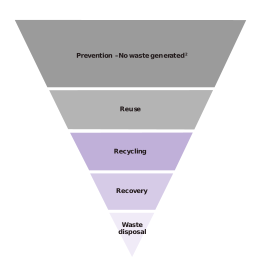
We are also guided by the European Union’s Waste Management Hierarchy, which is part of European environmental policy and established through the Waste Framework Directive (2008/98/EC). The hierarchy sets out a preferred order for managing waste: prevention first, followed by preparing for reuse, recycling, other recovery and, as a last resort, disposal. It is intended to support better resource use and reduce environmental and human health risks linked to poor waste management.
To help prevent and reduce waste, we consider durability and recyclability in design, work to align production with demand, use recycled materials where suitable, and offer services intended to support longer use of garments.
Our garment collecting programme sends collected textiles into partner-run routes based on their condition and the local systems available. Through Looper Textile Co., our joint venture with REMONDIS, a recycling and waste management company, we support textile collection and sorting capacity in Europe. Looper works with municipalities and retailers to collect and sort unwanted textiles, helping direct them towards reuse or recycling where possible, or other treatment routes used where these are not available, depending on condition and available infrastructure. As a founding partner of Syre, a textile-to-textile recycling company, we support efforts to increase the future availability of polyester recycling from textile waste.
Where relevant, we take part in policy discussions on waste management and the conditions needed to increase reuse and recycling, including infrastructure and recycled material topics.
Our role
Some levers or actions sit with us, such as providing return points, improving products and packaging, and setting clearer processes for waste in our stores and distribution centres.
Other levers depend on factors beyond our direct control, including waste collection systems, sorting infrastructure, and recycling capacity. Post‑consumer pathways therefore depend on local waste management systems and may change over time as infrastructure, technology and policy evolve.
Prioritised waste streams
Our waste management strategy focuses on three priority waste streams: product and packaging waste from our own operations; textiles collected from customers; and textile cutting waste from product manufacturing.
Waste from our operations1
In our own operations, most waste comes from packaging, with a smaller proportion coming from products that are returned as damaged or faulty. We review packaging to identify opportunities to reduce size, weight or unnecessary components. We also review packaging materials, including cardboard and plastic, with consideration for factors such as recyclability and local waste management systems.
Where possible, we prioritise reuse before recycling. If a damaged, faulty or recalled product cannot be sold through our own channels or via partners (such as outlets), we assess available routes based on factors such as product condition, legal requirements, product safety and local infrastructure. Depending on the item, this may include donation to charities, sale to sorting partners, recycling or, where no higher-value option is available, other treatment routes.
For some items, reuse or recycling is not always possible. There may be inadequate waste handling infrastructure or recycling technology for the product type, for example beauty products or ceramics. Incineration with energy recovery may be used where reuse or recycling is not possible and where required by local rules or product safety considerations.
Textile cutting waste in the supply chain
Textile cutting waste generated during production may be suitable for recycling or other recovery routes where appropriate sorting, material quality and recycling systems are available. Our suppliers follow guidelines to support sorting and recycling of post-industrial textile waste where possible. We are also working to connect suppliers with relevant recyclers using Reverse Resources, a digital platform that helps connect fashion brands, manufacturers, waste handlers and recyclers.
Textiles collected from customers
We launched our garment collecting programme in 2013 and offer garment and textile drop-off points in two-thirds of our selling markets. Customers can return garments and textiles of any brand. After collection, these items enter partner-run collection and sorting streams alongside textiles collected from other retailers and municipalities. This allows sorting and routing at a practical scale, although availability, infrastructure and sorting capacity differ by country.
Specialist operators sort the combined volumes by condition and material type. Where suitable, items may be directed to reuse. Where reuse is not possible, items may be directed to recycling, including lower-value recycling applications where suitable. Where recycling is not an option, items may be sent for incineration with energy recovery or disposal, depending on fibre type, available technology, local infrastructure and applicable rules.
We publish outcomes in our annual and sustainability report. These results reflect our partners’ combined sorting flows, not only items collected in our stores. In 2025, through our in-store Garment Collect programme, we collected 17,808 tonnes of garments. Across reported sorting outcomes, 60 percent was directed towards reuse, 29 percent towards recycling and 11 percent towards disposal routes.
Challenges in this area:
- Technology and blends: Many common fibre blends are not yet recyclable back to fibre at scale. Progress depends on sorting accuracy and evolving recycling technology.
- Different local systems: Collection, sorting and recycling systems vary by market, which affects how textiles can be reused, recycled or otherwise treated.
- No single pathway: Not every item can be reused or recycled. The next step depends on what the item is made from, its condition and the systems available.
How this connects to the rest of our work:
- Design decisions can support material efficiency by helping to minimise unnecessary material use and waste, as well as improve durability and recyclability.
- Packaging that uses fewer materials and avoids mixed-material layers or hard-to-separate components can be easier to sort and recycle where suitable systems exist.
- Services such as resale are intended to support longer product use before end‑of‑use pathways are needed.
1 Products discarded in our own operations (in stores or distribution centres) are included here. This includes textile products — garments and home textiles — accessories, hardware products, beauty products and chemical products (e.g. candles).
We publish our annual and sustainability report annually. In this document, we set out our activities and the progress we made in the previous year. Find the latest version here. More up-to-date information can be found on this page.
RELATED